
Drew Becker · 11 October 2026
Navigating Supply Chain Disruptions Through Localized Sourcing Strategies in Specialized Fabrication Networks
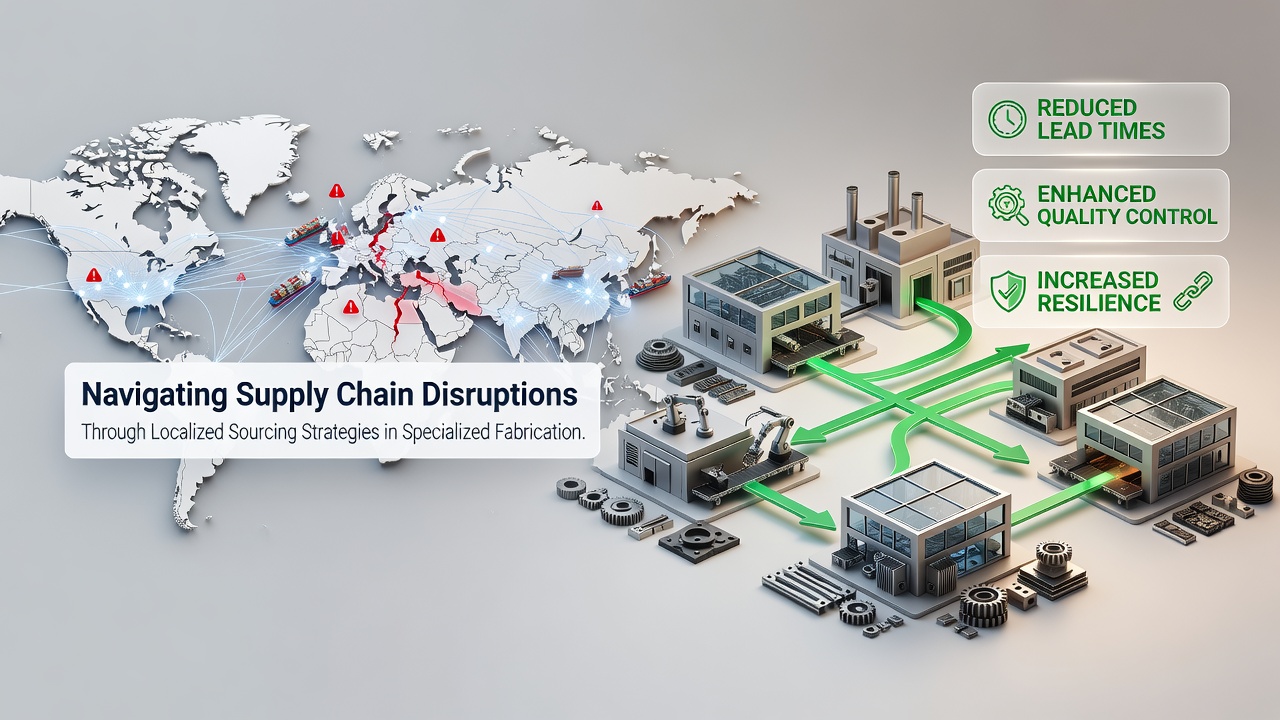
Specialized fabrication networks have faced repeated disruptions since the early 2020s, and observers note that localized sourcing has emerged as a practical response in sectors such as aerospace components, medical device parts, and precision tooling. Data from industry reports shows that companies reduced average lead times by 35 percent when they shifted procurement to suppliers within 500 miles of their main facilities, while global events continued to affect maritime routes and semiconductor availability into 2026.
Researchers at several technical universities tracked fabrication clusters across North America and Europe, and their findings indicate that networks relying on regional suppliers experienced fewer stoppages during the port congestion episodes reported in late 2025. Those clusters typically maintain shared databases of qualified machine shops, material processors, and finishing services, allowing rapid reallocation when one node encounters delays. In October 2026, several Midwestern fabrication groups reported completing rerouting exercises within 48 hours after a key titanium supplier in Asia declared force majeure, an outcome that would have taken weeks under previous long-distance arrangements.
Core Elements of Localized Sourcing
Localized sourcing in these networks rests on three documented practices. First, firms compile verified supplier directories that include capacity, certification status, and historical on-time performance; second, they establish pre-negotiated capacity agreements that activate automatically during shortfalls; and third, they integrate digital inventory platforms so that each participant sees real-time stock levels across the group. According to figures released by the US International Trade Administration, networks adopting all three elements recorded a 22 percent drop in expedited freight costs between 2024 and 2026.
But here's the thing: the transition requires more than simply finding nearby vendors. Specialized fabrication often involves tight tolerances and proprietary processes, so qualification cycles can extend six to nine months. Teams that began mapping secondary suppliers in 2023 found themselves better positioned when new tariff schedules took effect in early 2026, whereas those starting later encountered certification backlogs at testing laboratories.
Implementation Patterns Observed in 2025-2026
Case examples illustrate the pattern. One precision milling group in the Pacific Northwest created a shared tooling library with four neighboring shops, and this arrangement allowed them to absorb a sudden surge in orders for satellite brackets after a primary Asian source missed delivery windows. Production data shows the group maintained 94 percent on-time completion for the quarter ending September 2026. Another network in the German automotive supply region pooled material testing resources across five SMEs, cutting average inspection wait times from 11 days to four.
What's interesting is how these arrangements interact with regulatory changes. The European Commission published updated guidance in mid-2025 on due-diligence requirements for critical raw materials, and networks that already operated within a 300-kilometer radius found compliance documentation simpler because fewer border crossings were involved. Meanwhile, Canadian manufacturers participating in cross-border clusters with US partners reported smoother access to Defense Production Act priority ratings when components qualified as domestic content.
Technology Tools Supporting the Shift
Digital platforms play a measurable role. Cloud-based planning systems now connect machine availability, material certificates, and logistics bids in single dashboards. Studies conducted by university engineering departments indicate that networks using these integrated tools reduced schedule slippage by an average of 18 percent compared with groups relying on email and spreadsheet coordination. In addition, additive manufacturing cells placed at multiple sites allow rapid production of jigs and fixtures that previously required overseas sourcing, further shortening response times.
Observers note that data-sharing agreements remain the main friction point. Participants must balance competitive sensitivities against collective visibility, and successful networks address this through tiered access controls and third-party audit protocols rather than full disclosure. Those who've studied this know that legal templates for such agreements have standardized considerably since 2024, reducing setup time for new clusters.
Conclusion
Evidence from multiple regions demonstrates that localized sourcing within specialized fabrication networks delivers measurable reductions in lead-time variability and expedited costs when supported by shared directories, pre-negotiated capacity, and integrated planning tools. As conditions evolve through late 2026, the same structures appear positioned to accommodate further regulatory or logistics shifts without requiring complete redesign of supplier relationships.